
Why Do We Keep Having the Same Argument? How to Break the Cycle
Here's a claim most couples don't want to hear: the fight you had last night was never really about the dishes, the tone of a text message, or who forgot to call the plumber. If you've typed why do we keep having the same argument into a search bar at midnight, you're not broken and you're not alone. I've spent years reading the research on conflict cycles, and the pattern is remarkably consistent — couples don't fight about a hundred different things. They fight about the same two or three unmet needs, dressed up in a hundred different outfits.
In my experience talking with couples about this exact loop, the surface topic almost never matches the real trigger underneath. Once you can name that gap, the fight loses most of its power. Some couples work through this with a therapist; others use a daily structured tool like Cuddle to practice new conversation habits between sessions — it's one option worth exploring if you want a low-pressure way to start.

The Real Reason We Just Keep Having the Same Fight Over and Over
Relationship researcher John Gottman found that roughly 69% of conflict in long-term relationships is perpetual — meaning it never fully resolves, it just cycles. That statistic alone explains why you keep having the same argument over and over even when you both apologize and mean it. The topic shifts (money, chores, in-laws, sex, screen time), but the underlying need stays fixed: to feel respected, to feel prioritized, to feel safe, or to feel wanted. In my experience reviewing conflict transcripts from couples work, the words change every single time; the emotional temperature and the core wound almost never do.
Think of the surface argument as the tip of an iceberg. Underneath sits an attachment need that one or both partners learned early in life, long before this relationship existed. That's why our conversations always turn into arguments even when you start the conversation calmly — the moment the old need gets triggered, the nervous system takes over and logic takes a back seat. I've noticed this happens fastest when a couple is tired, hungry, or already stressed about something unrelated, which is part of why the same fight seems to appear at the worst possible moments.
Building Emotional Intimacy Is the Missing Repair Skill
So what is emotional intimacy, really? The clearest emotional intimacy definition I've found in the literature: the felt sense of being known, understood, and accepted by your partner, even in your less flattering moments. Building emotional intimacy is the single biggest lever for breaking a repeat-argument cycle, because most recurring fights are actually a bid for exactly that — to be seen.
Emotional intimacy examples look smaller than people expect. It's naming a fear out loud before it turns into snapping. It's saying "I felt dismissed when you looked at your phone" instead of "you never listen." It's asking a genuinely curious question after a hard day instead of offering advice. None of these require a grand gesture — they require consistency, which is exactly why a five-minute daily habit tends to outperform one big heart-to-heart every few months. Therefore, the couples who make real progress usually aren't the ones with the most dramatic breakthroughs; they're the ones who show up for small check-ins on ordinary Tuesdays.
When Lack of Intimacy Fuels the Cycle
A lack of intimacy — emotional or physical — often sits quietly underneath recurring arguments about completely unrelated topics. When couples stop feeling close, small irritations stop getting a generous interpretation. A late reply reads as rejection. A missed "good morning" reads as indifference. Left unaddressed, this is why couples keep fighting about the same things: the real issue (distance) never gets named, so it keeps leaking out sideways.
It's worth separating two related ideas here. Non sexual intimacy — eye contact, physical affection, shared humor, feeling emotionally safe — and sexual intimacy definition territory, which involves physical and erotic connection specifically. Both matter, and a shortage in either one can show up disguised as an argument about something else entirely, like whose turn it is to cook. However, couples who can label which kind of intimacy is actually missing tend to resolve the disguised argument much faster, because they're finally arguing about the real thing.
Long Distance Relationship Struggles Amplify the Pattern
Long distance relationship struggles deserve their own mention, because distance strips away the small in-person repairs — a hand on the shoulder, a shared laugh — that normally stop a disagreement from escalating over text. Without those cues, tone gets misread constantly, and couples often ask how to make a long distance relationship work when what they actually need is a replacement ritual for the physical repair they're missing. For example, a flat "fine" over text can read as anger when it was really just exhaustion, and that single misread word can spark the exact same argument you had last week.
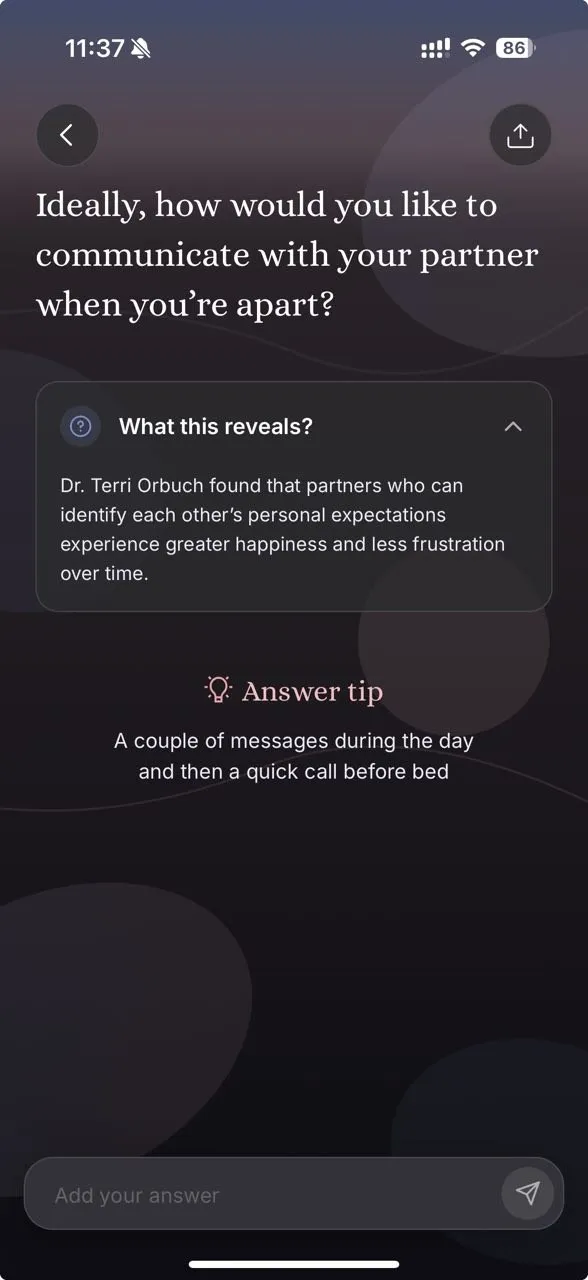
I've seen long-distance couples do well with a scheduled daily check-in — even three or four minutes of async questions can rebuild the sense of "we're still a team" that distance quietly erodes. This is one area where a structured daily prompt, whether through Cuddle's daily question feature or a shared journal you keep with your partner, tends to work better than sporadic long phone calls that only happen when someone's upset.
How to Improve Intimacy and Rekindle Romance in Marriage
If you're wondering how to rekindle romance in marriage after years of the same fight on repeat, start smaller than you think. How to improve intimacy usually isn't about a big romantic weekend — it's about lowering the emotional stakes of daily contact so both partners stop bracing for conflict. Try a two-minute check-in before bed: one thing that felt good today, one thing you need from your partner tomorrow. First, protect that two minutes from becoming another debrief about chores or logistics — it only works if it stays about connection.
For couples ready to go deeper, platonic intimacy — feeling like best friends again, not just co-managers of a household — often has to come back online before sexual intimacy improves. If you want how to spice up intimacy in a way that doesn't feel forced, curiosity is the ingredient most couples skip: ask your partner something you genuinely don't know the answer to yet. Books like Attached by Amir Levine cover the attachment-science side of this well, and a licensed couples therapist remains the right call for deeper ruptures — apps and books work best as daily reinforcement, not a replacement for professional support when things are serious.
How to Increase Physical Intimacy in a Relationship Without Forcing It
Learning how to increase physical intimacy in a relationship starts with non-demand affection — touch with zero expectation attached, like a hand on the back walking past each other in the kitchen. Couples who reintroduce small, pressure-free touch tend to see desire follow naturally within a few weeks, according to sex therapists who work with mismatched-libido couples regularly. When I've asked couples to try this for even ten days straight, the shift in general goodwill toward each other is usually noticeable well before any conversation about sex happens.
Furthermore, naming what physical closeness actually means to each of you removes a lot of guesswork. One partner might experience physical intimacy as sex specifically; the other might mean cuddling on the couch after the kids are asleep. Neither definition is wrong, but assuming you share one is a common, quiet source of the same fight over and over.
Want a Daily Reset for This Pattern?
Five minutes a day of guided questions and repair language, built for two real partners.
Try Cuddle Free for 7 DaysThe couples who break this cycle don't stop disagreeing — they just stop being surprised by the disagreement. Once you can spot the real need hiding under the surface topic, an argument becomes information instead of a threat. That shift, more than any single technique, is what actually ends the loop.
Disclosure: This page contains affiliate links. We may earn a commission at no extra cost to you.